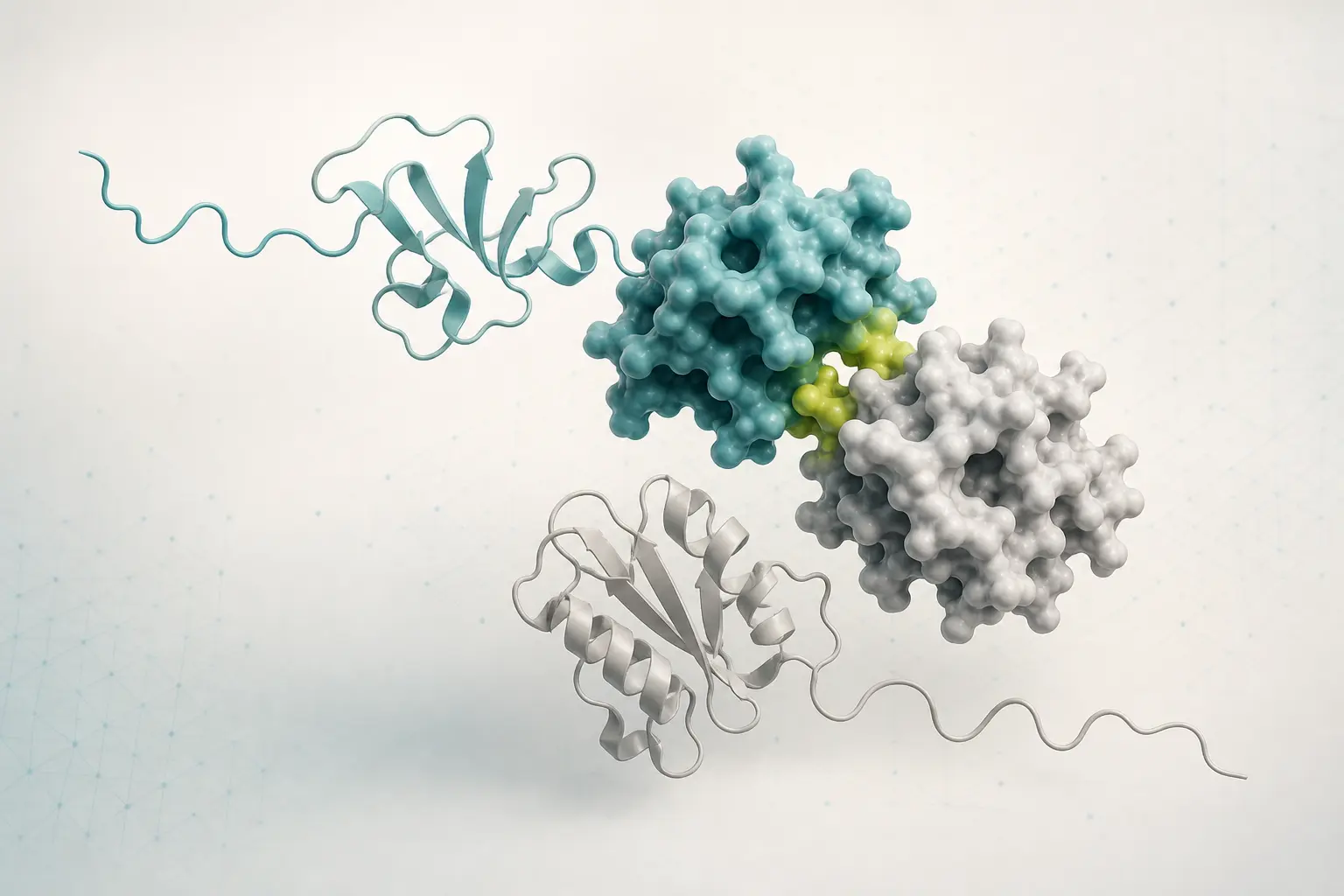
What Antibody modelling and computational design is designed to address
Antibody modelling and computational design is not a one-score software run. It is a reviewable analysis path organised around “How should binding interfaces, mutation directions and developability risks be prioritised for antibody candidates?”, beginning with input quality, comparators and intended use of evidence before selecting an appropriate methodological level.
The work centres on Antibody structure and CDR modelling, Antigen–antibody docking and interface analysis, Humanisation, affinity maturation and developability triage and links Antibody sequences or structures, Antigen structure and epitope information, Species, format and engineering constraints directly to Structural models with confidence notes, Interface interactions and mutation candidates, Developability risks and experiment list. Reporting separates supporting evidence, conflicting signals, parameter dependence and conditions for follow-up validation.
How should binding interfaces, mutation directions and developability risks be prioritised for antibody candidates?
Suitable research settings
- Projects that need to answer “How should binding interfaces, mutation directions and developability risks be prioritised for antibody candidates?”
- Studies requiring consistent comparison and quality control across Antibody structure and CDR modelling and Antigen–antibody docking and interface analysis
- Teams that need Structural models with confidence notes, Interface interactions and mutation candidates, Developability risks and experiment list with complete reproduction records
Analyses included in the service
Antibody structure and CDR modelling
Apply Antibody structure and CDR modelling to antibody sequences or structures and produce structural models with confidence notes. First confirm that antibody sequences or structures can support the downstream analysis.
Antigen–antibody docking and interface analysis
Apply Antigen–antibody docking and interface analysis to antigen structure and epitope information and produce interface interactions and mutation candidates. Use consistent systems, conditions and naming across adjacent steps so comparisons remain reviewable.
Humanisation, affinity maturation and developability triage
Apply Humanisation, affinity maturation and developability triage to species, format and engineering constraints and produce developability risks and experiment list. Use consistent systems, conditions and naming across adjacent steps so comparisons remain reviewable.
Select the methodological level for the question
| Method | Best suited to | Watch for |
|---|---|---|
| Antibody structure and CDR modelling | Establishing the input baseline and initial search space for Antibody modelling and computational design | Errors in Antibody modelling and computational design input state, structure or data definition propagate through later steps |
| Antigen–antibody docking and interface analysis | Comparing candidate states, features or mechanisms in Antibody modelling and computational design to form priorities | Antibody modelling and computational design comparisons require consistent conditions; raw scores are not experimental measurements |
| Humanisation, affinity maturation and developability triage | Reviewing key Antibody modelling and computational design results, interpreting differences and recording uncertainty | CDR-H3, flexible epitopes and glycosylation increase uncertainty; affinity, specificity and developability require experiments. |
From question definition to reproducible delivery
Frame the research question
Use “How should binding interfaces, mutation directions and developability risks be prioritised for antibody candidates?” to define comparators, decision use, experimental context and the strength of evidence the computation can support.
Review and curate inputs
Review Antibody sequences or structures, Antigen structure and epitope information, Species, format and engineering constraints; resolve structure, naming, unit, batch or microstate issues and record any remaining assumptions.
Design methods and controls
Combine Antibody structure and CDR modelling, Antigen–antibody docking and interface analysis, Humanisation, affinity maturation and developability triage with controls, replicates, sensitivity checks or independent evidence, defining decision criteria before computation.
Compute with quality control
Run Antibody modelling and computational design, including Antibody structure and CDR modelling, in a reproducible environment; retain inputs, versions, parameters, logs and intermediate outputs, and flag convergence, sampling, data-quality and applicability issues.
Interpret and deliver
Organise Structural models with confidence notes, Interface interactions and mutation candidates, Developability risks and experiment list while separating direct observations, model inference and working hypotheses, then prioritise experiments or follow-up computation.
What is needed and what is delivered
Inputs
- Antibody sequences or structures
- Antigen structure and epitope information
- Species, format and engineering constraints
Optional supporting inputs
- Known positive, negative or reference systems for basic expectation checks in Antibody modelling and computational design
- Replicate experiments, external databases or literature evidence relevant to Antibody modelling and computational design
- Timing, compute, software-compatibility or delivery-format constraints for Antibody modelling and computational design
Deliverables
- Structural models with confidence notes
- Interface interactions and mutation candidates
- Developability risks and experiment list
Quality control and interpretation limits
How results are reviewed
- Antibody modelling and computational design: Preserve functional residues, sequence constraints and construct boundaries
- Antibody modelling and computational design: Check structural confidence, interface geometry and conformational diversity
- Antibody modelling and computational design: Compare with natural sequences, negative controls and alternative models
- Antibody modelling and computational design: Keep expression, folding, affinity and function as experimental validation items
Boundaries that remain
- CDR-H3, flexible epitopes and glycosylation increase uncertainty; affinity, specificity and developability require experiments.
- Antibody modelling and computational design results apply only to the recorded inputs, parameters, models and sampling scope. Changes to input state, comparison conditions or project objectives may require new computation.
Common ways projects begin
From one system to comparable candidates
When antibody sequences or structures are available but decision criteria are inconsistent, establish baselines and controls, then use Antibody structure and CDR modelling, Antigen–antibody docking and interface analysis, Humanisation, affinity maturation and developability triage to build candidate tiers and deliver structural models with confidence notes with a difference analysis.
Independent review of existing results
When results relevant to Antibody modelling and computational design conflict, revisit antibody sequences or structures and analytical assumptions around Antibody structure and CDR modelling, then add replicates, sensitivity checks or alternative models to distinguish signal from method conditions.
Questions before a project begins
What is required before Antibody modelling and computational design begins?
The minimum inputs are Antibody sequences or structures, Antigen structure and epitope information, Species, format and engineering constraints. If information is incomplete, an input audit identifies which gaps change method selection and which can be handled as explicit assumptions.
Can the result directly prove “How should binding interfaces, mutation directions and developability risks be prioritised for antibody candidates?”?
No single model output should be treated as experimental fact. CDR-H3, flexible epitopes and glycosylation increase uncertainty; affinity, specificity and developability require experiments. Quality controls determine whether results support a priority or mechanism hypothesis; key conclusions still require appropriate experiments or independent data.
Which reusable files are delivered?
Typical delivery includes Structural models with confidence notes, Interface interactions and mutation candidates, Developability risks and experiment list, together with input-curation records, key parameters, software and database versions, quality-control results, editable figures and limitations. Exact raw formats are confirmed in the project plan.